
Download the Sheets
<< Click Here to Download the TEAM Exhibition Sheet >>
<< Click Here to Download the TANDEM Exhibition Sheet >>
<< Click Here to Download the SOLO Exhibition Sheet >>
Overview
Our Exhibition scoresheets are designed to accomplish two goals:
- Give the JUDGE the best understanding of how to use the scoresheet, assess the teams in competition, and effectively render a numerical score that accurately reflects their performance.
- Give the COMPETITOR the best snapshot of their performance through a given judge’s eyes in order to provide them with data from which to make future decisions.
After many, many years and many, many iterations, we are confident that our sheets provide the most intuitive experience for judges AND the most accurate encapsulation of the modern Exhibition drill activity. While they are different than most other commonly-utilized scoresheets both in format, scoring style, and grading criteria, after field-testing all three of these elements, we are confident that these sheets afford both judges and competing teams the best experience available today.
Using the Scoresheets
We designed these scoresheets to be followed by-the-numbers. We’ve also included an instructions box on each scoresheet should a judge need a quick reference for how to utilize them in real time. NOTE: This instructions box is NOT a replacement for a quality Judges Briefing!
As you read each of these descriptions, keep in mind that some items ONLY appear on the Head Judge scoresheet.
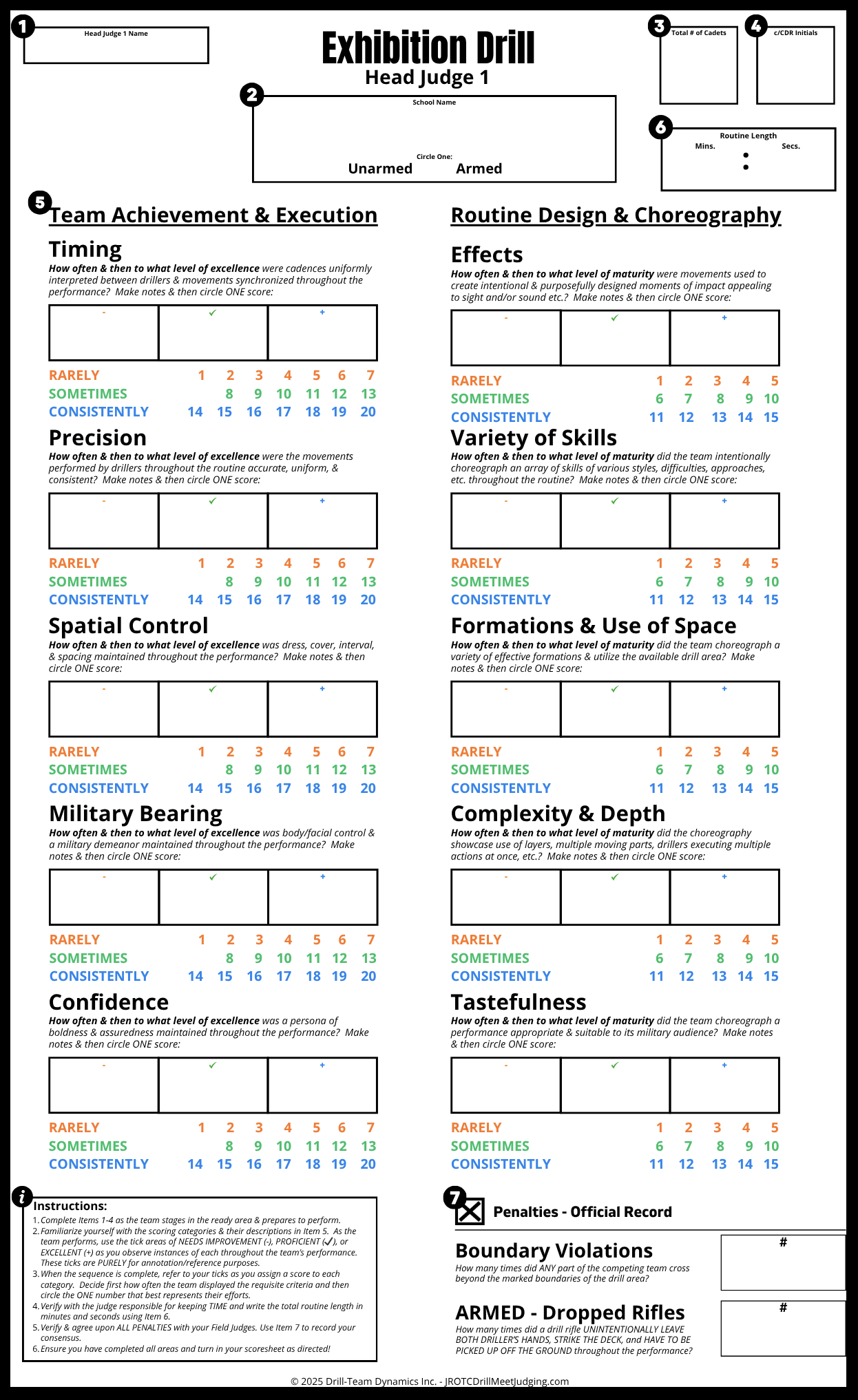
- Name – Each judge should CLEARLY PRINT their name (to include rank, if applicable) in this space. This is incredibly important as many meets break ties using specific judges and may want to verify that no judges have switched positions throughout the competition. All judges should use the SAME-numbered sheet from start to finish.
- School Name & Division – Write in the SCHOOL (and team, if applicable) NAME in this space. Be sure to circle in which division the team is competing so that scoresheets are not mixed up when being tabulated. This scoresheet can be used for EITHER unarmed OR armed drill.
- Total Number of Cadets (HJ ONLY) – When the team is staged, count EVERY SINGLE CADET to include the cadet commander(s) and document the number in this space. This is key because many meets have specific number requirements associated with penalties.
- Cadet Commander Initials (HJ ONLY) – Before beginning competition, the Head Judge should verify with the unit’s cadet commander that they are in fact the school scheduled and written on the scoresheet. This is also an opportunity to brief the cadet commander and allow for any questions. Collect their initials in this space.
- Scoring Rubric (ITEM 3 ON FJ SHEETS) – This is where notes and scores will be rendered. As the team performs, you’ll observe the team and make notes. As the team completes their performance, you’ll render scores in the most thorough, but expeditious, manner possible. Every scoring category should have only ONE circled numerical score!
- Routine Length – Every meet will have different parameters for when time starts and ends so confer with the meet host to verify these requirements. Write the total number of minutes and seconds in this space as all meets have some kind of time requirements with associated penalties.
- Penalties (ITEM 4 ON FJ SHEETS) – As the team performs, make note of any penalties here. Our suggested criteria for implementing these penalties is written on the scoresheets as clearly as possible. Hosts, if you wish to have a CUSTOMIZED VERSION made with your own meet’s specific penalty items, please CONTACT US!
Assigning Scores
You’ll notice that our method of assigning scores is a bit different than what you might be used to! However, don’t worry – this is VERY easy and helps the competitors by ensuring they more completely understand your scoring logic as a judge.
First, and most importantly, YOU WILL ONLY CIRCLE ONE (1) SINGULAR, LONE NUMBER PER SCORING CATEGORY. DO NOT CIRCLE MORE THAN ONE (1) SINGULAR, LONE NUMBER BELOW ANY SCORING CATEGORY AT ANY TIME.
Here’s how this works:
First of all, read and familiarize yourself with the scoring categories and their various criteria in advance. Reading the sheet explains the sheet and you’ll need to have a passing familiarity with each scoring category and where it is physically located on the sheet to do the best job. This is true of ANY scoresheet, but it’s worth repeating here.
Next, you’ll notice that below the name and criteria of each category, there is a segmented box:

This is your note-making area. The goal of this area is to help you visually track items of importance that you’ll want to take into consideration when circling your ONE (1) singular, lone score for that category.
As the team performs, use small tick marks to annotate observations. The MINUS represents observations where things may have missed the mark. If you notice poor timing with many cadets performing movements out-of-sync with one another, you would make a tick here, for example. The CHECK is represents neutrality, presence: neither exceedingly strong nor exceedingly weak, but present in the performance. You might use this area under VARIETY every time you see a unique skill on display, just to keep track. The PLUS represents observations of excellence. Perhaps there was a moment of exceptional DEMAND that you want to remember when you go to score the team; you’d make a tick in the PLUS box.
NOTE: Each scoring category lends itself to this annotation system differently. You may find yourself making MANY ticks in some categories and almost none in others. That’s a feature, not a bug. This should give you complete flexibility to use the notes area in the manner that will help you render the most accurate scores possible! Remember: the goal of this area is to help YOU as the judge!
Next, after the team has performed, you’ll notice that each scoring category asks you to make TWO (2) decisions:
- How OFTEN did X occur?
- To what DEGREE OF EXCELLENCE did it occur when it happened?
The first decision is about frequency. How often throughout the performance did the team demonstrate evidence of that particular scoring category? This will place your score in one of the three possible ranges associated with frequency. If the team RARELY displayed evidence of this criteria, their ONE singular, lone circled score should appear in this line. If the team SOMETIMES displayed evidence, it should appear in this line. If the team CONSISTENTLY displayed evidence, it should appear in this line.
Once you’ve decided how frequently the team displayed evidence of this category, you can then hone in on a specific score. This should be done in accordance with the principles of RANKING & RATING but, as a general rule of thumb, higher scores represent better performance.
A completed scoring category should look like this:

ONE circled number in the line that best represents how often that scoring category was on display!
Think about the scoring process like a spreadsheet you’re sorting with TWO criteria. Your first sort is how often, your second sort is how good. When you sort the entirety of that spreadsheet, the teams should be ranked in order of merit from top to bottom!
Important Considerations
How vs. What
The great thing about our scoresheet is that it CLEARLY delineates the two areas of drill being assessed in ANY phase at all times: HOW the drillers are performing (their achievement & execution) and WHAT the drillers are performing (their design and choreography).
You can see this delineation happening very clearly on the scoresheet above! Everything in the first section in some way asks about how well the team is performing whatever it is they have choreographed whereas the second section asks you to evaluate the design of the performance.
Obviously, each individual grading category has descriptions phrased as questions to answer. These should give you a GENERAL idea of what the category is assessing. Be sure to read and understand those – as well as be able to locate each category as quickly as possible so you can tick up your sheets as needed during the performance!
Audience
Exhibition drill is utilized by programs in a variety of ways: for public/community performance & demonstrations, for school functions such as pep rallies, as a recruiting tool to help attract middle school students to the program, for competitions of all kinds, etc.
Because of this, the “audience” that a team is performing to can vary widely and, sadly, in many cases, teams don’t consider who their audience is at all when composing their routines. And because designing an Exhibition routine is inherently a composition, we want to encourage teams to consider their audience extensively as they create their presentations.
When you see the word “audience” on the sheets, the first question you should ask is, “Is it clear that the team considered ANY audience?” Evidence of a lack of audience in the design process is generally drill that feels meandering and aimless – as though the team is checking off boxes as they traverse the drill floor. The second question you should ask is, “Did the team choose the RIGHT audience when it comes to this competition?” Teams may design performances designed to be really entertaining to their student body, middle schoolers, VFW posts, etc. and those might contain elements that go beyond the bounds of a more formal competition setting like this drill meet.
The bottom line is this: YOU are the audience. Or at least part of it. So any time you read “audience,” consider the scope of how Exhibition drill is used but also consider yourself part of it!
Next, we’re going to give you some items to think about for each category!
Scoring Category Explanations – Team & Tandem Exhibition
Timing
This is 100% about synchronization. Ignore angles, ignore differences from driller-to-driller. JUST consider whether what you SEE and, just as importantly, HEAR is synchronized. The fewer different moving parts there are, the more obvious this will be. Some teams will have multiple groups of drillers doing different movements at the same time, rippling movements in a variety of directions, etc. In those cases, you’re still evaluating synchronization in both the micro (are like groups/drillers moving in time with one another within their different groupings) and macro (does the team as a whole still maintain coordinated synchronization despite the varying pieces.)
Precision
Here, we’re looking at angles, body positions, poses, etc. If you took a picture at ANY time in the routine and looked at that snapshot in isolation, would the angles be the same? Would the bodies be carried the same way? Would everyone doing the same thing in that moment look uniform? In ALL drill, everything should be uniform and intentional. Now, precision errors may CAUSE timing errors – and we should reflect those case in both Timing AND Precision. But here, we’re mostly concerned with uniformity from driller to driller whenever they are positioned in like ways.
Spatial Control
This is the EASIEST category on this sheet because it’s just dress (alignment side-to-side), cover (alignment front-to-rear), interval (consistent, intentional side-to-side distance between drillers), and distance (consistent, intentional front-to-rear distance between drillers). Even if the team is not arranged in a traditional “block” or “line” formation where dress and cover play a major role, you can still evaluate their spacing as part of their CONTROL of SPACE!
Military Bearing
Drill is separated from its cousin-performing arts by its adherence to a stoic, rigid demeanor. Military bearing first asks us to evaluate control of facial expressions, control of secondary movements (i.e. “wiggling,” etc.) and those basic core components of bearing. But this category also asks you to look at a driller’s control of their body and form. While Exhibition does not necessarily need to adhere to the basic Position of Attention, body control DOES need to be intentional and controlled. When bringing rifles to the deck, do the hands returned to a uniform, specific position? When conducting Unarmed Exhibition, does the torso remain controlled and intentionally positioned? All of this is bearing.
Confidence
Drillers who are well-practiced and highly-skilled conduct their movements with comfort and intentionality. Drillers who are developing may still struggle with follow-through when it comes to performing their routines. Check into body language, subtle facial expressions (especially eyes), etc. to determine how confident the team APPEARS to be on the drill floor!
Effects
We want teams to think about INTENTIONALLY making artistic choices about their routines, not just “doing drill.” Here, we’re looking for evidence that the team thought, “The goal of us doing THIS sequence is because it’s going to be visually appealing on purpose.” If you notice a moment where how it LOOKS is the focus of a moment, that’s this category. Unlike cheer, dance, or marching band, drillers make their OWN music with the rhythmic sounds they can produce. Turn your ears on here and listen for evidence that the team thought, “The goal of us doing THIS sequence is to create audible rhythm.” If you notice a moment that’s driven by how it SOUNDS, that’s also this category.
Variety of Skills
In ARMED drill, every manual, spin, toss, or exchange is a different skill. Teams who are developing might use fewer skills. Highly-established teams will display a multitude of skills. Team ability level begets the inclusion of more and more skills as they learn and grow and we want to reward BOTH the inclusion of many skills AND the avoidance of excessive repetition of skills that seems to indicate that the “well ran dry.” (Note: intentionally repeating a skill on purpose for a specific effect is different than just running out of things the team knows how to do and repeating as a result.). In the same way UNARMED, every beat, every new style of arm movement, differing types of timing, etc. are all considered different skills. Look at the variety of arm and body positions – moving the arms is NOT one skill as a whole. Look at whether the team kneels, stands, etc. If it’s something new they’d need to practice, it’s a new skill when it comes to Unarmed Exhibition!
Formations & Use of Space
At most competitions, the drill area is a unique stage because judges can move all around it to see what the team is doing. This category asks us to consider FIRST how many unique formations the team used throughout the performance. While they may have some repeating formations – and not EVERY formation needs to be unique – we do want to encourage teams to explore a wide variety of orientations. SECONDLY, we’re looking for whether the use of the space was effective, intentional, and purposeful. Do they stay in one spot but use a lot of formations in the middle of the floor? That hits the first wicket but perhaps misses the second. We want to look for evidence that there was both thought put into displaying a range of formations AND that every movement around the floor was intentional and purposeful.
Complexity & Depth
This category asks you to assess the dimensionality of the choreography. Drill teams enhance the demand of their performances and showcase their skill level by choreographing increasing layers of complexity AND by asking each performer to add stacked responsibilities. Complexity & depth looks like multiple moving parts within a particular piece of choreography such as ripples, multiple sequences that line up rhythmically or visually, etc. It also looks like drillers being asked to do more than one thing once; for example, marching while spinning a drill rifle adds depth when compared to JUST marching or JUST spinning by itself. If it looks like there’s more than just one thing at one time happening, that’s this category!
Tastefulness
Rather than scoring “military flavor” (a term we’ve specifically omitted after observing there is essentially no uniform, standard consensus on what this means because the military is not a monolith but an institution made of diverse people with varying tastes), our sheets as judges to look for instances of choreography or performance that seem inappropriate for or unbecoming of a military performance venue. While there is great latitude – and again, no consensus on – what may constitute “inappropriate,” common examples include:
- Gymnastics/Acrobatic Maneuvers: The inclusion of movements of an athletic nature like splits, pyramids, basket catches, etc. are almost universally regarded as being outside the bounds of what is appropriate to perform in a military uniform
- Excessive Levity: While performances appropriate for a military venue may contain or lean on elements of humor or lightheartedness, performances which contain excessive lampooning are generally regarded as being outside the intent of the Exhibition phase of drill competitions.
- Breaking the Fourth Wall: Generally speaking, addressing or interacting with the judges directly in a manner that acknowledges their existence and includes them in facets of the choreography is generally regarded as being out of place in a drill competition.
- Uniform Violations: When the SOP specifies the appropriate range of uniforms with great clarity, wearing unauthorized items or combinations could result in the application of this penalty.
- Excessive Loss of Military Bearing: Cadets visibly confused, laughing at what’s occurring on the floor, uttering curse words, etc. are all examples of distasteful content within a performance. This could also apply to the inclusion of choreography that requires excessive facial expressions or the excessive breaking of the connection between the head, shoulders, AND torso. It should be noted that we do NOT consider movements inspired by step team to constitute distasteful content unless they meet the description above. Step is arguably one of the first forms of military exhibition drill and hosts are encouraged to avoid the common phrasing that “step team” or “stomp the yard” are unacceptable and instead focus on what about that genre (i.e. the bearing/form/etc.) differs from the expectations of military exhibition drill.
Scoring Category Explanations – Solo Exhibition
Precision
Same as above applied to a singular driller.
Body Control
Rather than group the control of torso, limbs, hands, and feet into Military Bearing, we’ve separated these specific elements into their own category as this is something solo drillers should strive constantly to master.
Military Bearing
Bearing now refers to the same as above with the exception of any elements of torso, limbs, hands, or feet!
Comfort
Comfort asks us to consider how well-rehearsed the performer looks in TWO dimensions. In the micro, we can look at how they handle the rifle to see whether moving it in the non-standard ways often required of solo exhibition seems natural and comfortable to their body. Does it seem like the skills they’re performing have been honed to the point of comfort or does the body seem to struggle to manipulate the rifle? In the macro, we’re looking for how comfortable the driller is with their own choreography. Does the performance display evidence that the driller isn’t “winging it” and improvising but instead is delivering a well-rehearsed, seamless performance? Does it look like they’re thinking hard about what comes next (or even making it up in real time)? This is all comfort.
Confidence
Same as above applied to a singular driller.
Effects
Same as above applied to a singular driller.
NOTE: It’s more likely in solo drill that the ONLY real effects the performer will have considered are excellence as an effect (i.e. being GOOD is aesthetically, emotionally, and intellectually appealing) and showcase of ability (i.e. doing a lot of skills is aesthetically, emotionally, and intellectually appealing). Judges should look for evidence of intentionally-crafted moments designed to have impact, NOT just a showcase of ability/skills.
Variety of Skills
Same as above applied to a singular driller.
NOTE: This refers not only to diversity of movements but also the style in which those movements occur. We want to encourage young performers to become dynamic, learning a variety of styles and genres in the same way a young musician will explore rock, blues, classical, and more to become a well-rounded musician.
Demand
This category asks us to consider how physically or mentally challenging it APPEARS to be to perform the choreography. It does not ask us to RATE THE ACTUAL DIFFICULTY of movements (i.e. how hard something REALLY is to do if you’re proficient at it) but instead asks the performer to showcase their overall mastery by including skills that showcase their superior strength, endurance, or coordination.
Use of Space
Same as above applied to a singular driller (and in absence of any criteria referencing “formations.”)
Tastefulness
Same as above applied to a singular driller.
NOTE: The condition of the drill rifle(s) used and the quality of uniform preparation should be of special concern in a solo competition. The cleanliness, quality of preparation, and evidence of forethought all apply to this category as performing for an audience with a crusty, dirty rifle showcases a lack of thought as to the tastefulness of the presentation
Let’s Practice
COMING SOON!
This module is part of The Definitive Guide to Judging Drill Meets!