
Overview
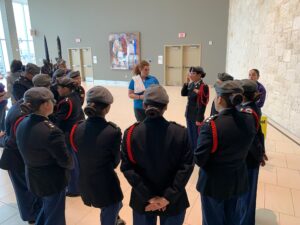 When it comes to practicing, there should NEVER be a time when we perform a repetition WITHOUT immediate feedback being given. Repetitions without feedback are referred to as “empty reps” and should be avoided at all costs.
But one of the things that commanders, instructors, leaders, etc. are rarely taught is how to provide feedback in an athletic performing arts context like drill team. This article is designed to give you a repeatable framework for HOW to give feedback to your team!
After the Rep
One of the things we need to be in the habit of is freezing with perfect bearing after the MOTION has concluded. Drill is not solely movement, it’s also the stillness and military bearing that FOLLOW a movement. This means we need to remain still and silent in the final position of the rep until verbally released from the rep. This helps us build military bearing.
After the movement is performed, drillers should NOT immediately move or break bearing. We recommend using “Break” or similar to release the team from the rep quickly.
Good
After being released from the rep, the first kind of feedback that should be delivered is what went WELL about the rep. Drillers often struggle with this because we’re so attuned to look for things that are WRONG that we often overlook what was GOOD. However, without specific, intentional feedback about what to sustain into the future, the team won’t have a complete picture of how to improve.
The first thing out of your mouth should be what was GOOD.
EXAMPLES:
“Wow! We were really locked in. No one moved after the rep! Great bearing!”
“Y’all! We really did a good job of staying in cadence this time around! Let’s keep that up!”
“Hey! We all actually did the move that time! Let’s go!”
Better
After pointing out what was good about the rep, the next thing out of your mouth should be something we need to do BETTER the next time. Notice, we did not say what was BAD or WRONG with the rep. There is a world of difference between, “the alignment is trash” and, “the next time around, we need to do a better job of focusing on alignment.” One of the toughest things that drillers struggle with is reframing negative feedback into areas for improvement but by focusing on what can be BETTER, we build a resilient mindset of constant improvement.
Point out what we’re going to do BETTER next time.
EXAMPLES:
“Next time, we need to make sure that we start together in time right on the command of execution.”
“On this next rep, we need to focus harder on making sure our angles are consistent from person to person.”
“We can do a better job of finishing the rep even if we mess up in the middle going forward.”
How
Here’s the kicker. Here’s where mid feedback becomes good feedback and good feedback becomes great feedback. The first two stages of feedback are DIAGNOSTIC: they point out things that happened and describe what occurred. The HOW phase of feedback is where we describe what we’ll do in order to get better the next rep. Pointing out that our alignment needs improvement is one thing but prescribing the fix is quite another all together. This is easily the most neglected stage of feedback because it’s the hardest. It requires actually seeing what happened, understanding why it happened, and synthesizing this information into actionable steps that can be taken in real time.
Part of being a leader is honing THIS particular craft; being able to tell the team HOW we’ll improve is key.
EXAMPLES:
“When you hear the preparatory command, begin engaging your muscles so that you’re ready to move at exactly the right time. If we wait until the command of execution to squeeze our muscles, we’re going to start moving too late.”
“To keep those angles consistent, make sure we’re all raising our elbows until they are in line with our shoulders, not too low or not too high. Then, make sure we’re all aiming for the same 45-degree angle with our forearm.”
“Make sure that if you slip-up or miss a count, you immediately anticipate where you can hop back in with the rest of the group, even if that’s only for the very last count so we end together.”
Conclusion
How you give feedback is the difference between spinning your wheels with minimal improvement and making huge strides day-over-day. The strongest leaders we’ve taught become outstanding at not only diagnosing the problems but seeing the good AND prescribing fixes to help improve going forward. Just like drill, this process is something to be practiced, honed, and refined over time! But knowing how we should give feedback is over half the battle!